

Alibaba unveils full-stack AI push with new Qwen chips
Fri, 2nd Oct 2026
Alibaba outlined a full-stack artificial intelligence strategy spanning chips, cloud infrastructure, models and agents, including a new AI processor and an update on the Qwen model family.
The company presented the roadmap at its annual Apsara Conference in Hangzhou, where executives described AI as the next major computing shift and tied the strategy to rising demand for large-scale model training and inference.
At the centre of the announcement was Qwen 4, now in training. Alibaba also set out plans for later versions in the Qwen line, including Qwen 4.5 and Qwen 5, with models expected to reach between 5 trillion and 10 trillion parameters.
Alibaba also disclosed new details about work on recursive self-improvement, or RSI, in model development. Qwen3.8-Max completed 33 iterative cycles over more than a month of automated runs covering pipeline design, data validation, iterative experimentation and error diagnosis.
The updated version of Qwen3.8-Max lifted its Artificial Analysis score from 40 to 45 through autonomous training optimisation and post-training techniques.
Chip plans
Alongside the model roadmap, T-Head, Alibaba's chip design unit, introduced the Zhenwu V900 AI processor for training and inference workloads. The chip delivers three times the performance of the earlier Zhenwu M890, released in May.
The processor carries 216 GB of GPU memory and 1,200 GB/s of inter-chip bandwidth, according to Alibaba. It supports several data precisions, including FP8 and FP4, and is designed to handle both model training and low-precision inference.
The chip is scheduled for mass production and commercial release in the first quarter of 2027.
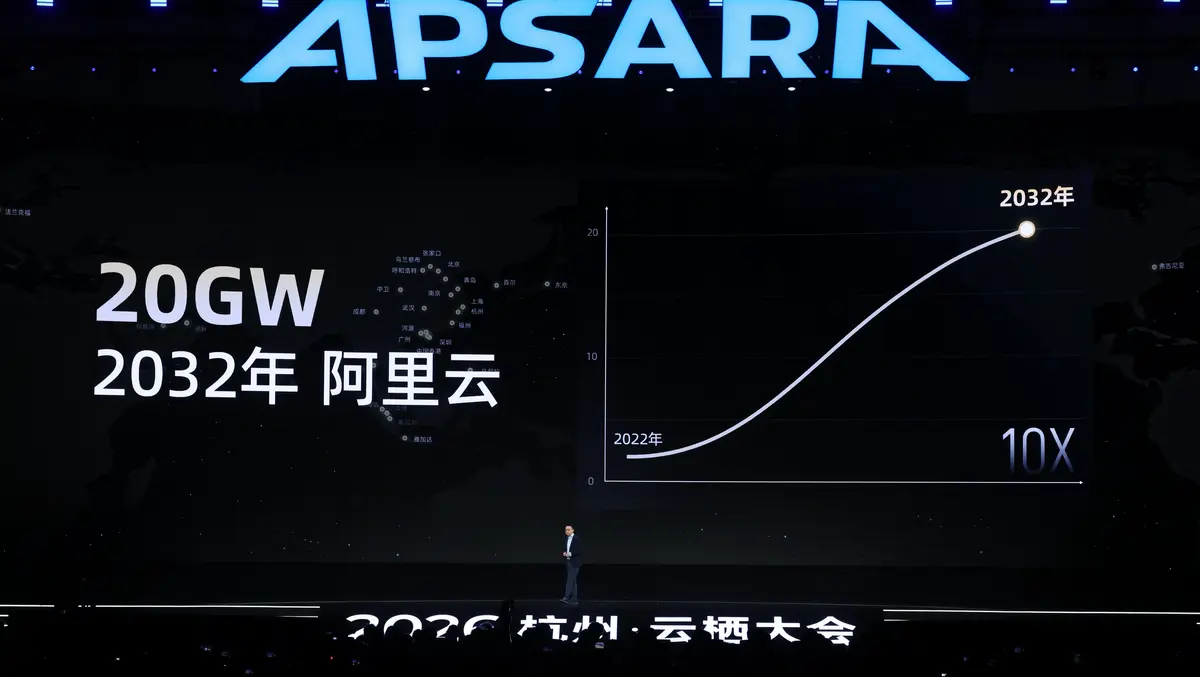
Alibaba also used the event to link its hardware plans to a broader infrastructure target. Eddie Wu, Chief Executive Officer of Alibaba, said the company expects a steep increase in demand for AI computing over the coming years.
"Today, the total volume of Machine Thinking is less than 3% of all Human Thinking. If that volume eventually scales to 1,000x human capacity, the simple math tells us: Machine Thinking still has an enormous growth runway. As machines are becoming the primary force behind Thinking, turning intelligence into a commodity supplied at scale, the truly groundbreaking products of the Machine Intelligence era have not yet arrived," Wu said.
"With this in mind, our target is that by 2032, the global data center capacity operated by Alibaba Cloud will surpass 20GW, fueling the industry's exponentially rising demand for AI," he said.
Model updates
Beyond the flagship foundation models, Alibaba announced updates across speech, audio and vision systems. One of the new products, Qwen3.8-LiveTranslate, is a simultaneous interpretation model that cuts latency measured by LAAL by nearly 20%, reducing it from 2.8 seconds to 2.3 seconds.
Another addition was Qwen-Audio-3.1-TTS-Next, a text-to-speech model that can generate dialogue and ambient sound together from a script. It is intended for uses including audiobooks, film and television, podcasts and games.
Alibaba also updated three other speech tools: Qwen-Audio-3.1-ASR, Qwen-Audio-3.1-TTS and Qwen-Audio-3.1-Realtime. In image generation, Qwen-Image 3.1 is due to launch later this year with functions including transparent-background generation and image editing.
Cloud layer
Alibaba framed the product announcements within what it called an agentic cloud strategy, organised around three areas: model, harness and context.
These correspond to three layers in its cloud offering: AI Native Cloud for model training and inference, Agent Native Cloud for agent deployment and operation, and Context Engine for real-time data and long-term memory.
The strategy reflects a broader push by large cloud and internet groups to package AI systems as a stack combining processors, model development, deployment tools and data management. For Alibaba, the announcement also signals an effort to position its in-house silicon and Qwen model family as core parts of that stack.
Joe Tsai, Chairman of Alibaba, tied the AI push to commercial adoption across industries.
"The theme of this year's Apsara Conference is 'Intelligence Goes Beyond'. Over the past few years, AI has continuously expanded our imagination of technological capabilities. AI possesses vast potential for development-it can be deployed and scaled in real-world scenarios, boosting productivity across thousands of industries," Tsai said.
"This is the true meaning of 'Intelligence Goes Beyond': guiding AI from technological breakthroughs toward value creation," he said.