

AMD launches 6th Gen EPYC chips for AI data centres
Wed, 11th Nov 2026 (Today)
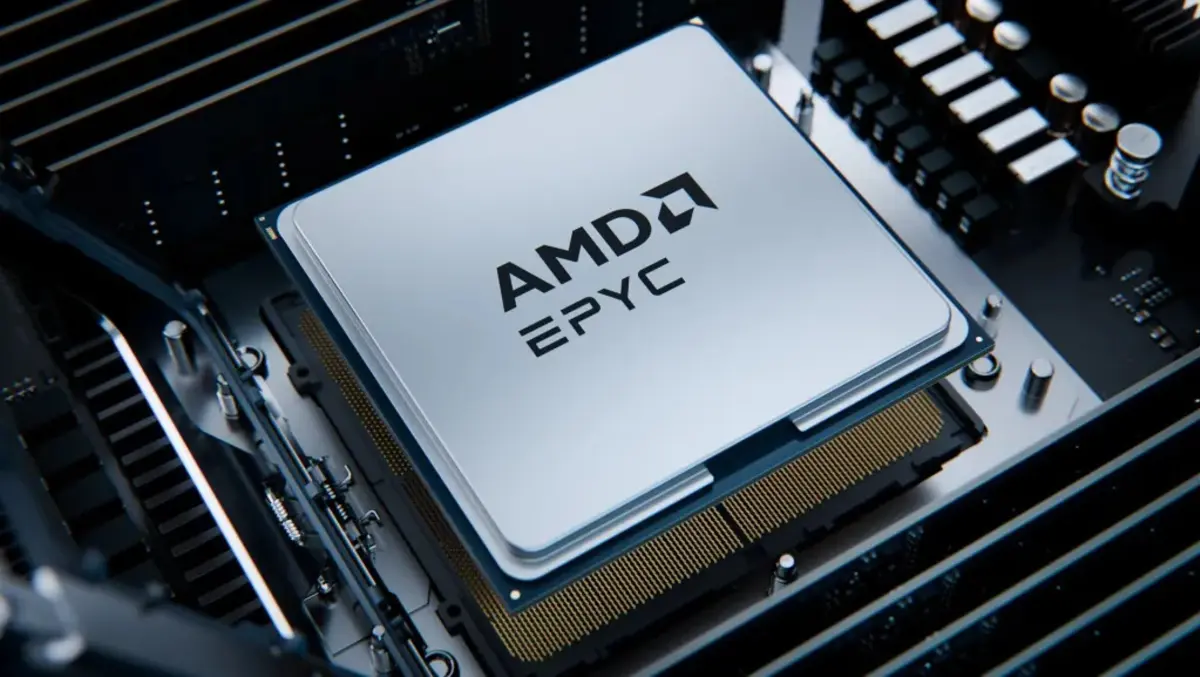
AMD has launched its 6th Gen EPYC server processors and the new EPYC Embedded 9006 Series. The server chips are now shipping in systems from major hardware vendors.
The new server range is based on AMD's Zen 6 architecture and targets data centre workloads across enterprise applications, cloud computing, high-performance computing and AI.
AMD said the 6th Gen EPYC portfolio is designed for different CPU roles in AI infrastructure, including general-purpose services, GPU host nodes and agent sandbox environments. Cloud deployments are planned across major providers, including Microsoft Azure and Oracle Cloud Infrastructure.
In benchmarks cited by AMD, the top-end EPYC 9996 chip delivered up to 2.2 times the performance of Intel's Xeon 6980P and up to 3.7 times the performance of Nvidia's Vera CPU. AMD also said the line offers up to about 3.3 times the agents-per-watt of Nvidia Vera for agentic AI workloads.
Those claims come as chipmakers try to define the CPU's role in AI systems that also rely heavily on accelerators. AMD's position is that processors remain central to orchestration, data access, enterprise applications and host functions around AI models.
"AI is significantly expanding the role of the CPU across every layer of the data center," said Dan McNamara, Senior Vice President and General Manager, Compute and Enterprise AI, AMD. "With 6th Gen AMD EPYC, customers can standardize on the proven x86 foundation while choosing a workload-optimized solution to run more agents, keep accelerated infrastructure fed and power the business-critical applications they depend on."
Cloud rollout
Server systems using the processors are shipping from leading original equipment manufacturers and original design manufacturers, according to AMD. Meta is working with AMD as a lead customer and has been validating platforms based on the new chips ahead of wider deployment.
Microsoft Azure is preparing several services tied to the new processors, including Azure HDv2 for AI data processing, agentic AI and high-performance computing, and Azure HXv2 for electronic design automation and technical computing. Azure ND MI455X v7, based on AMD Helios, is also cited for production-scale AI inference.
Oracle Cloud Infrastructure is also set to use the processors in OCI Compute E7 instances for enterprise applications and CPU tasks surrounding AI models. AMD presented the breadth of support as evidence that the product line is aimed at both conventional enterprise computing and newer AI-linked infrastructure.
Embedded push
Alongside the server announcement, AMD introduced the EPYC Embedded 9006 Series for applications such as semiconductor test equipment, network security and enterprise storage. The chips offer up to 256 cores, next-generation connectivity and seven-year product longevity, according to AMD.
The embedded release broadens the reach of the EPYC brand beyond mainstream server deployments at a time when processor vendors are trying to capture demand across a wider range of infrastructure categories. Buyers in embedded markets often prioritise long support cycles and stable supply as much as raw compute performance.
Rack strategy
AMD also outlined its Helion rack approach for AI deployments, with liquid-cooled and air-cooled designs as well as a configuration that combines CPU execution with local GPU inference in one rack. Some configurations can reach up to 73,728 threads in a single rack, according to AMD.
The pitch reflects growing interest in rack-level design rather than standalone server performance as operators seek to balance compute density, energy use, cooling and networking. Across the market, suppliers are increasingly packaging CPUs, GPUs and interconnects as integrated infrastructure rather than separate components.
AMD's latest launch extends a product line that has steadily gained share in the server market over several generations. The company said its 5th Gen EPYC family was the fastest-ramping and highest-volume EPYC generation in its history, setting the backdrop for this release.
For customers assessing server platforms, the key questions will centre on performance under real workloads, energy use, system availability and software support across existing estates. Systems powered by 6th Gen EPYC server processors are shipping from leading server vendors, AMD said.