Quantum error correction (QEC) stories
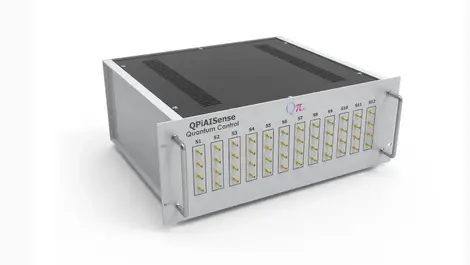
Hardware-based decoding could help keep superconducting qubits stable, with QpiAI's system now correcting errors in about 1.5 microseconds.
The hardware cut error-correction time on its 64-qubit processor to about 1.5 microseconds per cycle, helping quantum systems stay within coherence limits.
QuEra survey finds quantum buyers and backers are demanding stronger proof of value, even as 46% of organisations expect budgets to stay flat.
The move broadens Google's bet on fault-tolerant machines as rivals debate whether superconducting qubits or neutral atoms will scale fastest.
Quobly unveils silicon spin-qubit roadmap to 2032, targeting million-qubit quantum processors built on industrial FD-SOI manufacturing.
Quantum Machines unveils Open Acceleration Stack to link GPUs and quantum control with microsecond-latency hybrid orchestration.
PsiQuantum links Nvidia CUDA-Q to its Construct toolkit, promising GPU-accelerated quantum simulations up to 450 times faster than CPUs.
Quobly and Entropica join forces in Singapore to co-design fault-tolerant silicon quantum systems from chip architecture to software stack.
Firgun backs Los Angeles quantum start-up Quantum Elements to scale its AI-powered Constellation software platform for circuit design.
Quantum Machines will open a flagship quantum hub in Chicago's Illinois Quantum and Microelectronics Park to expand US research operations.
Riverlane launches an AI-driven quantum error correction hub in Delft, led by Barbara Terhal, bolstering its European R&D footprint.
Quobly starts running custom silicon-28 FD-SOI quantum wafers at STMicroelectronics' Crolles fab, aiming at scalable million-qubit processors.
HPE cements supercomputing lead as its exascale systems take the top three TOP500 spots and half of the Green500's 20 most efficient.
Riverlane reveals a hardware quantum error decoder that corrects surface code qubit errors in under a microsecond in real time.
Quobly starts processing silicon-28 FD-SOI quantum wafers in an ST fab, linking a European supply chain towards million-qubit processors.
NTT and OptQC will collaborate to develop a 1-million-qubit optical quantum computer operating at room temperature by 2030, targeting complex industrial challenges.
Quantum error correction is now the chief challenge in the global quantum computing sector amid rising investments and acute talent shortages.
HPE leads eight-tech group Quantum Scaling Alliance to develop scalable quantum supercomputers for real-world industrial and scientific use.
Fujitsu begins building a 10,000-qubit quantum computer, using STAR architecture, aiming for completion in 2030 to advance practical applications beyond classical computing.
Riverlane boosts its quantum software efforts by appointing Abe Asfaw and Guen Prawiroatmodjo to lead quantum error correction and open-source SDK development.