

Delta unveils 800 VDC power & cooling for AI data centres
Tue, 17th Mar 2026
Delta has outlined a range of power, cooling, and microgrid products it is presenting at NVIDIA GTC, built around an 800 VDC architecture that the companies describe as targeting next-generation AI data centres.
The line-up includes in-row power racks with battery backup, megawatt-scale liquid cooling distribution units, and a microgrid configuration combining solid-state transformers, fuel cells, and energy storage. Delta developed parts of the showcase in collaboration with Nvidia.
Delta is positioning 800 VDC as a route to higher-density AI computing, where power delivery and thermal management are increasingly becoming constraints.
"The 800 VDC power architecture proposed by NVIDIA for the AI factories of the future is a game-changer and an ideal opportunity for Delta to further cement its global leadership in power and thermal management, and to advance its system integration capabilities in data center and energy infrastructure. Moreover, as AI systems push electrical and thermal limits, we are excited to showcase here at NVIDIA GTC the depth and breadth of our solutions that are designed for how future AI factories are actually built, powered, cooled, and operated efficiently," said Franziskus Gehle, Vice President, Delta Electronics (Americas), Delta.
Power racks
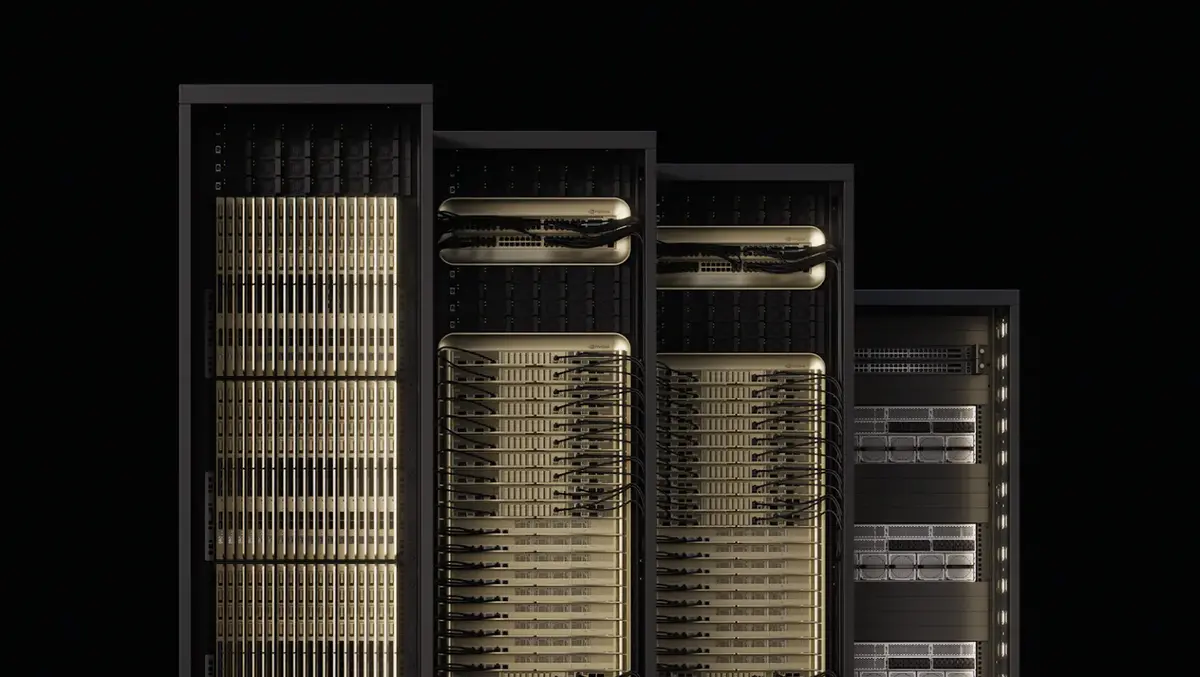
A core element of the display is an 800 VDC in-row 660kW power rack design with battery backup integrated into each power shelf. The configuration provides 480kW of embedded battery backup across the rack.
The rack uses six 110kW power shelves, each with an 80kW battery backup unit.
Delta also described a newly developed 18.5kW AC/DC power supply unit that it says reaches up to 98% energy efficiency and uses aluminium capacitors for energy storage. It links the design to GPU workload behaviour and high-frequency dynamic distortion.
Alongside the 800 VDC rack, Delta is also showing power components tied to Nvidia's MGX architecture, including a 1RU 90kW DC/DC power shelf, a 1RU power capacitance shelf, and a management switch.
Liquid cooling
On the thermal side, Delta is presenting liquid-to-liquid cooling distribution units designed for high heat densities in AI systems.
For 800 VDC environments, it is highlighting a new 2.4MW in-row coolant distribution unit, offering 2,400kW of cooling capacity and using self-contained 800 VDC electrical pumps. The system has an N+1 redundant pump design and what Delta calls "unique cooling channel designs".
Delta lists the 2.4MW unit's footprint as 1,500mm wide, 1,200mm deep, and 2,286mm high, and says it can reach an approach temperature as low as 4°C.
Also on display is a 3MW liquid-to-liquid CDU that Delta says delivers up to 3,000kW of cooling capacity, with 1.5 LPM/kW and 50 psi hydraulic performance. The system scales to eight units operating as a group.
Delta is also showing a 4RU in-rack 140kW liquid-to-liquid CDU associated with Nvidia's GB300 NVL72 configuration. It uses plate-type heat exchangers to transfer heat from a server-side secondary liquid loop to a primary facility water system.
In addition, Delta is debuting microchannel cold plate designs using a bonding technology it says reduces flow resistance, linking the design to cooling requirements for the latest generation of AI servers.
Microgrid mix
Beyond rack power and cooling, Delta is emphasising a microgrid approach for sites using 800 VDC distribution. Its package integrates solid-state transformers, solid oxide fuel cells, an all-in-one energy storage system, and an energy management system.
Delta says its solid-state transformer converts medium-voltage AC to 800 VDC, uses high-frequency power electronics, and reaches up to 98.5% efficiency.
It also highlights solid oxide fuel cell technology as an on-site generation option, linking it to quieter operation and lower CO2 emissions than traditional gas turbines. Delta says solid oxide fuel cells can reduce "time-to-power" from years to months.
For energy storage and controls, Delta says its system supports modelling and simulation at power-plant scale, with real-time control offering millisecond-scale response time and stable system voltage within required parameters.
Retrofit narrative
Delta describes the products as an end-to-end infrastructure stack for AI data centre architectures. It also outlines a path from today's 415 VAC data centres to environments incorporating 800 VDC for next-generation accelerated computing, without what it calls costly retrofits.
Delta is also featuring a GTC conference session on 800 VDC and modular data centre designs, presented by Ralf Pieper, R&D Director in Delta's Custom Design BU, and Jason Agee, Director of Data Centre Solutions at Delta Americas.
As Nvidia and its partners promote denser AI system designs, suppliers such as Delta are putting greater emphasis on power delivery, liquid cooling, and on-site energy options as constraints on new data centre builds and expansions.