

Marvell targets AI connectivity bottleneck with NVIDIA boost
Wed, 3rd Jun 2026
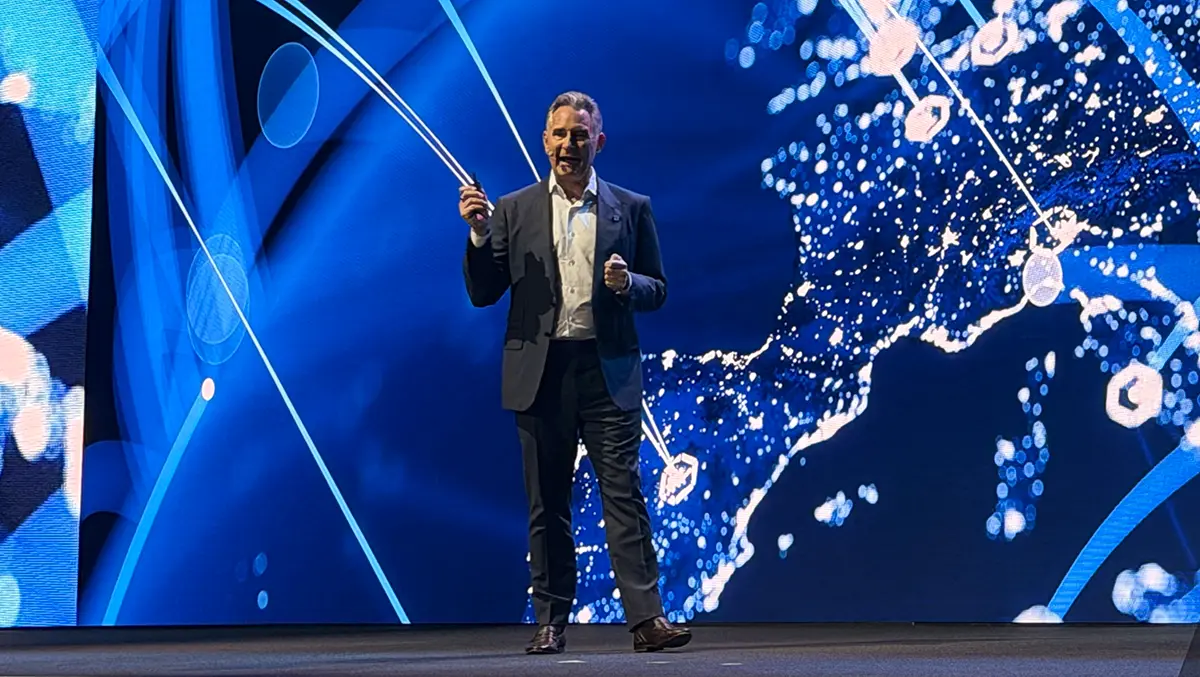
Marvell is positioning optical connectivity as the next major battleground in AI infrastructure, as Chairman and CEO Matt Murphy says the industry's scaling challenge is moving beyond processors and memory to the networks that connect increasingly large compute clusters.
Connectivity shift
Murphy said AI infrastructure performance is increasingly defined by how quickly and efficiently data can move across systems, racks, data centres and larger distributed compute environments. That shift is already changing how hyperscalers design AI data centres.
"One processor, no matter how fast it is, no matter how much memory it has attached to it, is simply not enough for today's AI workloads, because you need tens of thousands, and eventually millions, of processors working together as a single massive compute engine," said Matt Murphy, Chairman and CEO, Marvell.
"Computing at this scale is fundamentally a connectivity challenge, and increasingly it is the architecture and characteristics of connectivity that defines the performance of the system," said Murphy.
Murphy said Marvell has spent the past decade rebuilding itself around data infrastructure. The company has shifted away from a business once heavily exposed to consumer devices and towards semiconductors used to move, store, process and secure data at scale.
Data centre accounted for less than 10% of Marvell's revenue when he joined the company in 2016, Murphy said. In the most recent quarter, it represented more than 75% of revenue. He also said Marvell has invested about USD$22.5bn through acquisitions and USD$18bn organically, while divesting about USD$4.5bn of assets. That amounts to a net investment of roughly USD$36bn in its data infrastructure platform.
"The vision we had at that time was pretty simple, and this is still the same vision that we have today, 10 years later, which is to build a best-in-class pure-play company focused on semiconductor solutions for data infrastructure," said Murphy.
Marvell's M&A strategy has included the USD$10bn acquisition of Inphi in 2021, which strengthened its data centre connectivity portfolio, as well as deals for Avera, Aquantia, Innovium, Celestial AI and XConn. Murphy said the result is a platform focused on data movement, including optical interconnect, switching, custom silicon and advanced packaging.
Optical scale
Marvell argues that copper will remain important but will increasingly hit physical limits as bandwidth rises. Murphy said copper's practical reach shrinks as data rates increase, making optical links necessary in more parts of the data centre.
"The distance a signal can travel over a copper cable is inversely proportional to the bandwidth, so every time you double the bandwidth, you have to cut the distance in half," said Murphy.
At 200 gigabits per second per lane, copper cable length is limited to roughly 2.5 metres, compared with about five metres at 100 gigabits per second, he said. That puts current copper systems near the limit of what can be routed within a rack. At 400 gigabits per second, the industry will no longer be able to fully connect the rack with copper, Murphy said.
"When we move to 400 gig, we can no longer fully connect the rack with copper, so the wall is moving, and it's moving now," said Murphy.
The shift is driving interest in co-packaged optics, or CPO, where optical connections are brought close to compute or switching silicon inside the package rather than through pluggable modules at the front panel of a system. Murphy said CPO is designed to solve both density and power challenges, because the number of connections inside the rack is far higher than the number between racks.
"The fundamental challenge we're solving with CPO is density and power," said Murphy.
Marvell used the event to show a CPO-based switch design alongside a traditional Ethernet switch. Murphy also said the company had announced a new 100T Ethernet switch designed for AI data centres and began ramping 1.6T 3nm PAM4 solutions last year. He said Marvell also plans to sample what it describes as the world's first 1.6T 2nm coherent optical solution later this year.
Nvidia partnership
The connectivity push is also tied to Marvell's partnership with Nvidia. Murphy said Nvidia has invested USD$2bn in Marvell as part of an expanded strategic relationship covering optics, photonics and NVLink Fusion.
"Useful AI has arrived," said Jensen Huang, CEO, Nvidia.
"It's the reason why your demand is going through the roof, it's the reason why my demand is going through the roof, and this new computing pattern that makes it possible is called agents," said Huang.
Huang said agentic AI workloads require a distributed computing pattern in which tasks are broken into many parts and run across large clusters. That makes connectivity central to AI infrastructure, particularly as systems scale beyond individual servers and racks.
"When you take a computing problem and you disaggregate it into a lot of parts and you distribute it across the entire data centre, what's necessary is connectivity," said Huang.
He said copper should continue to be used where practical, but optics will be required as systems scale further and distances increase.
"We should use copper as much as we can for as long as we can, but copper has its limits," said Huang.
"Ultimately, the right strategy is to scale up with copper as much and as long as you can. After that, you scale up further with optics, and you scale out with optics, and you scale across with optics," added Huang.
Huang said AI demand is now being driven by the economics of token generation and the wider deployment of useful AI applications.
"AI is profitable, and tokens are profitable," said Huang.
"When token production is profitable, everybody wants to make more tokens, which is the reason why Marvell's demand is so high," added Huang.
Taiwan supply
Murphy also linked Marvell's strategy to Taiwan's semiconductor supply chain, saying optical connectivity will require manufacturing capacity, advanced packaging and long-term ecosystem investment. He cited Advanced Semiconductor Engineering, or ASE, as one of Marvell's key partners.
ASE Chief Executive Dr Tian Wu said the relationship reflected a long-term bet on Marvell's direction and future infrastructure requirements.
"The first decision was not difficult," said Dr Tian Wu, CEO, ASE.
"Marvell, a fabulous company, has a very good reputation and has gone through a lot of transition, so the track record from Marvell has already been there," said Wu.
Wu said semiconductor manufacturing requires capacity decisions years before demand fully arrives, making alignment with customers important.
"Taiwan ASE is in the manufacturing sector, so we're looking not only to bet on your success, we're also betting on somebody who can provide insight for the next generation architecture and also the technology requirements," said Wu.
Taiwan's semiconductor ecosystem has been built across several technology shifts, from PCs to wireless, mobile computing, data centres and high-performance computing, Wu said. That accumulated experience makes the supply chain difficult to reproduce quickly elsewhere.
"When you think about the workforce with years of experience behind it, when you think about the cluster efficiency, when you think about the capacity, economy of scale, we already have this," said Wu.
"I think this ecosystem is very, very difficult to replicate. It is not impossible, but will take years," added Wu.
Murphy said Marvell's longer-term view is that optical connectivity could change data centre architecture by reducing today's distance constraints between compute, memory and networking resources. He described a future in which systems are composed dynamically from pools of compute and memory connected optically, rather than fixed around current board- and rack-level limits.
"For the first time, architects can begin designing AI systems around the needs of the model, not around the limits of the interconnect," said Murphy.