


Black Box Automation vs. Engineer Control: The partnership redefining Kubernetes FinOps
Fri, 24th Apr 2026
Kubernetes adoption is no longer the hard part. Running it efficiently is.
As organizations scale their container workloads across multiple clusters and cloud providers, a familiar pattern emerges: infrastructure costs climb, resource waste silently compounds, and platform teams spend more time firefighting than building. The tooling to address this exists, but choosing the right approach matters more than most teams realize.
At Kloia,that's the backdrop behind our partnership with Kubeadapt.io. We believe Kubernetes cost optimization should be practical, transparent, and built for real engineering workflows.
Most organizations overprovision their Kubernetes clusters by 50–70%. The reasons are understandable. Nobody wants to be the engineer whose cost-cutting caused an outage at 2 AM. So teams set generous resource requests, add buffer nodes, and watch monthly cloud bills grow quarter over quarter.
The challenge isn't awareness. Platform teams know they're overspending. The challenge is acting on it safely:
- Rightsizing without risk: How do you reduce CPU and memory requests without triggering OOM kills or throttling?
- Visibility without noise: How do you separate actionable savings from dashboard clutter?
- Governance without friction: How do you prevent cost waste before it reaches production, without slowing down developers?
- Planning without guesswork: How do you model infrastructure changes (spot instances, ARM migration, node consolidation) before committing?
These are the questions our clients ask us regularly.
Kubeadapt is a Kubernetes cost optimization and observability platform designed around one principle: give teams the information and tools to act without taking control away from them. Unlike black-box automation tools that make changes on your behalf, Kubeadapt provides deep visibility, actionable recommendations, and one-click fixes, keeping engineers in the driver's seat.
Kubeadapt delivers not just cluster-level totals, but granular breakdowns by namespace, workload, container, team, and department with historical trends going back 360 days. It supports custom queries, allocation tracking, infrastructure cost analysis, and forecast modeling. Teams can finally answer "who's spending what and why" with precision.
Container-level rightsizing recommendations based on actual usage patterns - not just averages, but p50, p75, p95, and p99 metrics. Kubeadapt flags over-provisioned deployments, abandoned workloads, and misconfigured resource limits, then provides one-click fixes to apply changes safely. Engineers see exactly what will change and why before they act.
A full capacity planning suite that goes beyond simple utilization charts. Kubeadapt analyzes node groups, pod density, spot vs. on-demand distribution, availability zone costs, and utilization patterns by hour. It includes:
- Spot migration assessment - workload-level eligibility scoring with risk analysis and blocker detection
- Smart Alerting - with Slack/Teams/Email and Webhook integration, custom thresholds, and severity routing
- Graviton/ARM analysis - identify which node groups can migrate to ARM-based instances, with savings projections and migration complexity ratings
- What-if simulator - model the impact of switching to spot, consolidating node pools, or migrating to Graviton before making any changes
- Node group visualization - see your current and optimized infrastructure side by side, with per-node cost and utilization data
Automated checks against Kubernetes best practices, resource limits, PodDisruptionBudgets, probe configuration, replica strategies, and more. Each finding comes with context, impact assessment, and remediation guidance. This isn't a generic compliance scan. It's tailored to cost and reliability trade-offs.
When evaluating Kubernetes cost optimization tools, CAST AI and Kubecost are often part of the conversation. Each is a capable platform, but their underlying approaches reflect fundamentally different philosophies. For transparency, here is a comparison of key features across Kubeadapt and these solutions:
Note: This comparison is based on publicly available feature documentation as of Q2 2026.
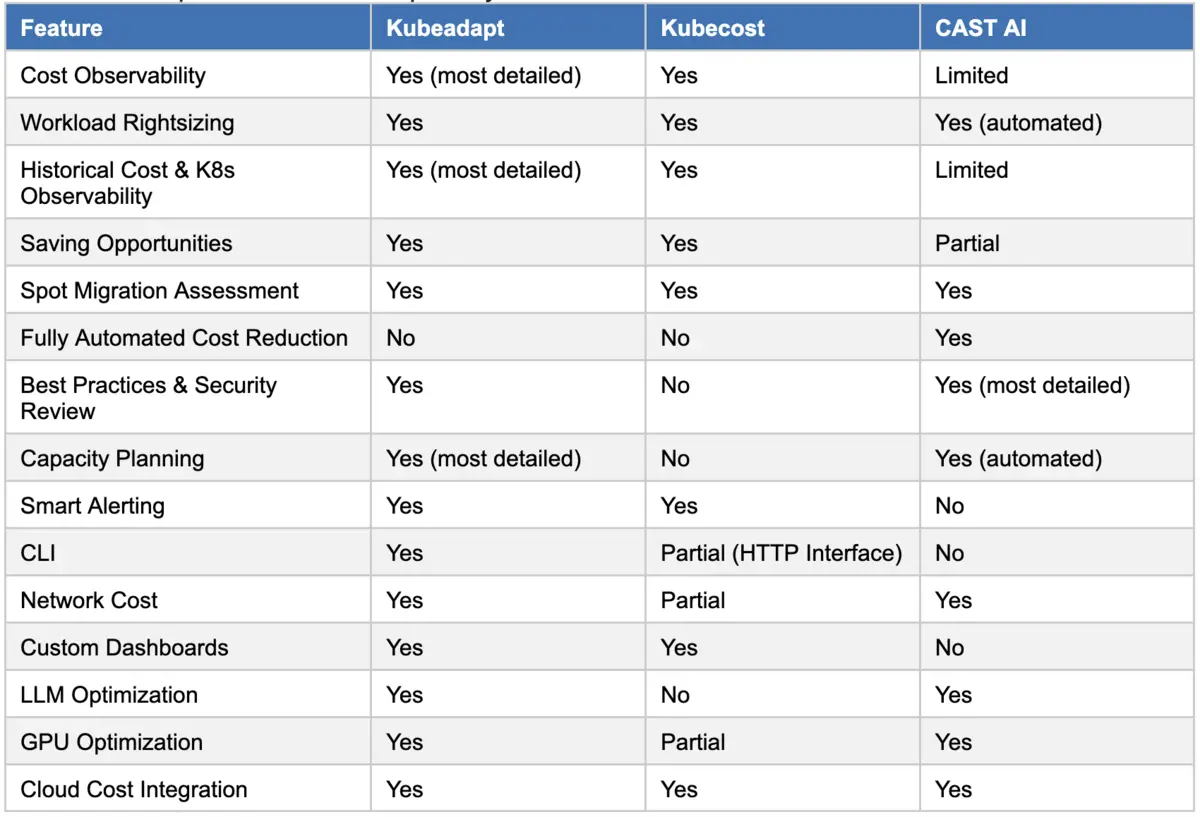
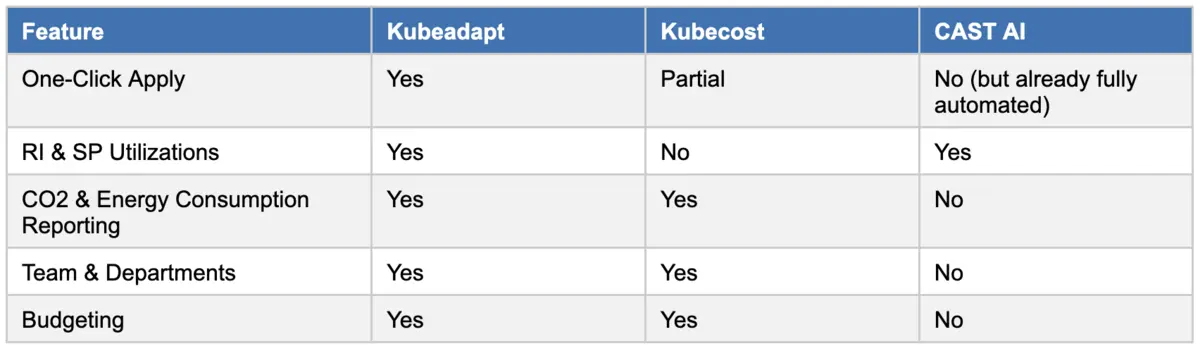
Observability-first vs. automation-first. CAST AI leads with automation by managing your nodes, resizing your workloads, and handling scaling decisions for you. Meanwhile, Kubeadapt leads with observability and recommendations. You see everything, understand the trade-offs, and decide when and how to act. For consulting partners like us who work across diverse client environments, this transparency is essential.
When we operate across dozens of client environments, the choice of tools isn't just about features; it's about trust, flexibility, and fit.
Transparency builds client trust. Our clients need to understand what's being recommended and why. Kubeadapt's recommendation engine shows the data behind every suggestion, usage percentiles, cost projections, and risk assessments. There are no opaque "trust us" optimizations.
Flexibility across environments. We work with AWS, Azure, GCP, and on-premises clusters. Kubeadapt supports all of them without requiring cloud-specific agents or proprietary infrastructure. One tool for every environment.
Safe, incremental optimization. Rather than automated changes that could impact production workloads, Kubeadapt's one-click fixes and cost gates let teams optimize at their own pace. For clients in regulated industries or with strict change management processes, this is non-negotiable.
FinOps enablement, not just cost cutting. The initiatives system, team performance tracking, and department-level cost allocation help us build lasting FinOps practices at client organizations, not just one-time savings.
Fast time-to-value. Cluster onboarding takes minutes, not weeks. In many cases, we can show a client real savings opportunities within the first minute of connecting a cluster.
Adopting this approach means integrating five core steps into the engineering workflow:
- Assessment: connecting clusters to establish a baseline of cost and resource utilization
- Strategy: building a prioritized optimization roadmap based on observed data and engineering priorities
- Implementation: applying rightsizing and infrastructure changes while maintaining full visibility and safety controls
- Governance: setting up cost gates and alerting to maintain ongoing cost discipline
- Continuous improvement: tracking optimization initiatives and measuring the sustained efficiency gains
This shared approach helps organizations run Kubernetes the way it should be run: efficiently, reliably, and with full visibility.
As Kubernetes environments grow more complex, the organizations that thrive will be those that build cost discipline into their engineering culture - not as a reactive measure, but as a continuous practice.